
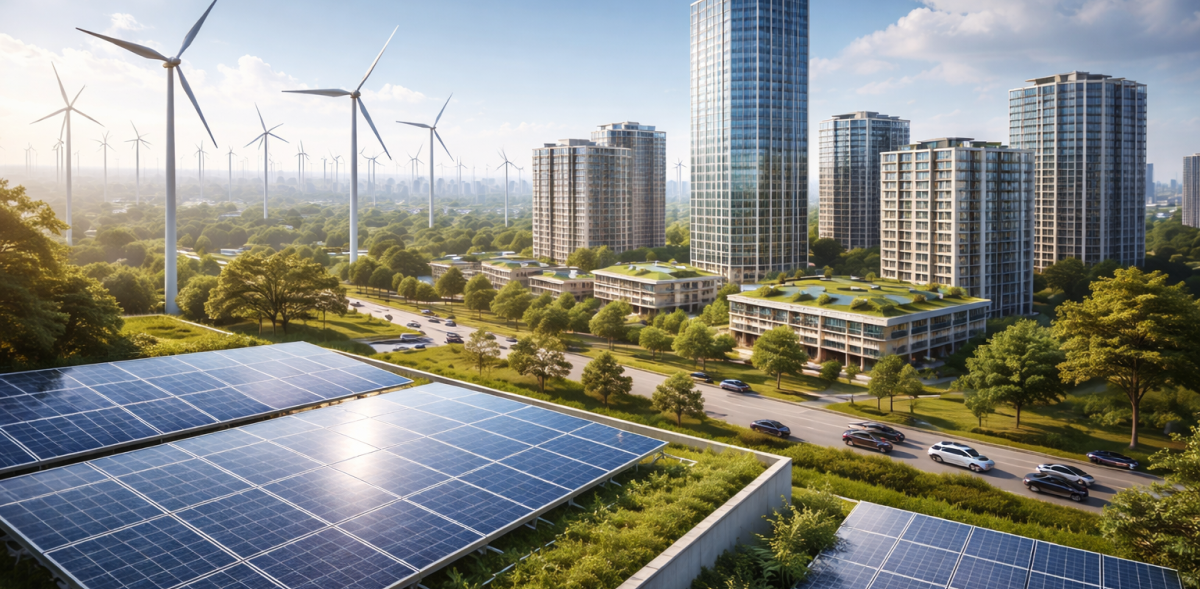
Real Estate and Renewable Energy: A New Frontier in Asset Development
Nov 19, 2025
The global investment landscape is undergoing a fundamental transformation, driven by the urgent need for
sustainable growth, energy security, and resilient asset performance. At the center of this transformation lies the
convergence of real estate and renewable energy — two sectors that were once developed independently, but are now
increasingly intertwined. For forward-looking investors, this convergence is not simply a trend, but a structural
shift that is redefining how land, infrastructure, and capital generate long-term value.
Real estate has traditionally been evaluated through location, yield, and market cycles. However, rising energy
costs, regulatory pressures, and climate commitments have expanded the definition of asset value. Today, land and
buildings are no longer passive holdings; they are platforms capable of producing energy, reducing operational risk,
and enhancing investment resilience. As governments and institutions accelerate the transition toward cleaner energy
systems, real estate assets that can integrate renewable infrastructure are emerging as strategic cornerstones of
modern portfolios.
Renewable energy, by its nature, is land-dependent. Solar installations, wind farms, energy storage facilities, and
hybrid infrastructure require carefully selected locations with long-term development potential. This reality has
elevated the strategic importance of land and property assets, particularly those situated near infrastructure
corridors, industrial zones, or emerging urban centers. Investors who understand this relationship are no longer
choosing between real estate and energy — they are structuring investments that benefit from both simultaneously.
The financial implications of this integration are significant. Energy-enabled real estate assets introduce new
revenue streams that extend beyond traditional rental income. Power purchase agreements, grid feed-in mechanisms,
and infrastructure leasing can generate stable, long-term cash flows that complement property income and reduce
exposure to market volatility. At the same time, properties that generate or manage their own energy often
experience lower operating costs, increased tenant demand, and enhanced asset attractiveness in competitive markets.
Institutional capital has taken notice. Pension funds, sovereign wealth funds, and long-term investors are
increasingly prioritizing assets that align with environmental, social, and governance principles. Energy-integrated
real estate offers measurable sustainability outcomes while preserving the income stability and capital appreciation
traditionally associated with property investments. As ESG considerations move from preference to requirement,
assets that combine real estate fundamentals with renewable energy capacity are becoming central to capital
allocation strategies.
Despite its promise, the integration of real estate and renewable energy is not without complexity. These projects
require coordination across zoning laws, environmental regulations, energy licensing regimes, and financing
structures. Without careful planning, misalignment between stakeholders or regulatory oversight can undermine
long-term performance. This is where disciplined investment structuring becomes essential.
Effective structuring ensures that landowners, developers, energy operators, and capital providers operate within a
unified framework. Governance mechanisms define decision-making authority, risk allocation, and revenue
distribution, while legal structures anticipate regulatory changes and protect investor interests. By addressing
these elements at the outset, investors can avoid operational friction and preserve flexibility over the asset’s
lifecycle.
From a strategic perspective, governance is as critical as sustainability itself. Energy-linked real estate projects
are inherently long-term, often spanning decades. Clear governance frameworks provide transparency, reduce disputes,
and ensure that assets can adapt to evolving market conditions and policy environments. In this context,
sustainability is not limited to environmental impact — it extends to financial durability and operational
continuity.
As global energy systems evolve and real estate adapts to new economic realities, the distinction between property
and infrastructure continues to blur. Assets that combine land, energy generation, and long-term planning are better
positioned to withstand economic uncertainty, regulatory shifts, and market disruptions. They offer investors not
only financial returns, but strategic relevance in a rapidly changing world.
The future of real assets lies in integration. Real estate that can support renewable energy infrastructure
represents a new frontier in asset development — one where value is engineered through foresight, structure, and
alignment. For investors seeking resilient, future-oriented portfolios, the convergence of real estate and renewable
energy is no longer optional. It is the foundation of the next generation of global investment strategy.